

What Can I Build on My Honolulu Property? 7 Things to Check Before You Make Plans

Thinking about an ADU, addition, remodel, second story, or new home? Before you pay for drawings, here are seven things that can affect what may actually be possible on your Oʻahu property.
You look at your backyard and think:
There’s plenty of room back there. Why couldn’t I build an ADU?
Or maybe your house feels too small and you’re wondering:
Could we push this wall out another 15 feet? Add a second floor? Tear the whole thing down and build something bigger?
Those sound like simple questions.
In Honolulu, they often aren’t.
That’s because what you can build depends on more than the amount of empty space you can see from your kitchen window.
Your property has a zoning designation. It has a recorded lot size. There are rules about yards and setbacks, how much of the lot can be covered by buildings, how much total floor area can be built, and how tall a structure can be. Your property may also be affected by flood zones, special districts, shoreline conditions, or other mapped restrictions.
So before you start sketching your dream addition—or paying someone else to sketch it—start with these seven things.
Want to skip ahead and see what applies to your actual property?
Enter your Oʻahu address into our Honolulu Property & Zoning Checker for a free first look using official Honolulu and FEMA data.
1. What Is Your Property Zoned?
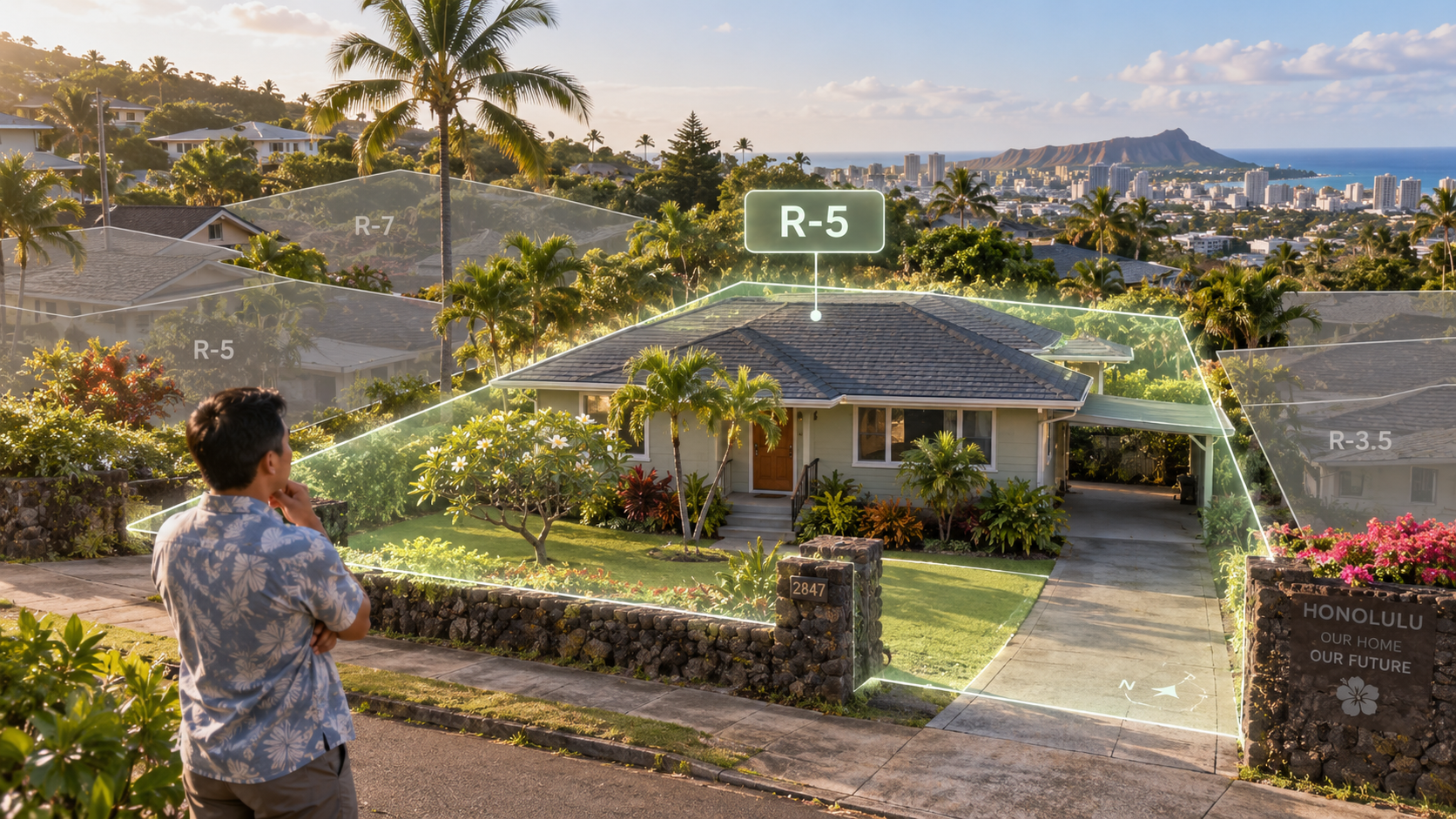
This is the logical starting point.
A Honolulu property might have residential zoning such as R-3.5, R-5, R-7.5, R-10, or R-20.
Those letters and numbers aren't just labels.
They help establish basic rules for the property, including minimum lot sizes, yards, building area, height, and other development standards. For example, Honolulu's current residential zoning table lists minimum lot areas of 3,500 square feet for an R-3.5 single-unit dwelling lot, 5,000 for R-5, 7,500 for R-7.5, 10,000 for R-10, and 20,000 for R-20.
But here's the important part:
Knowing your zoning does not, by itself, tell you what you can build.
Think of zoning as the first clue—not the final answer.
Two homeowners with the same zoning designation can have very different options because their lot sizes, existing houses, property shapes, and other conditions are different.
If you don't know your zoning, you can look it up simply by entering your address in the Honolulu Property & Zoning Checker.
2. How Big Is Your Lot?
This sounds obvious, but lot size can change the answer to some very big questions.
And you shouldn't rely on:
"The Realtor told us it's about 5,000 square feet."
The actual parcel information matters.
Here's a good example.
Under Honolulu's current Accessory Dwelling Unit rules, an ADU can have up to 500 square feet of floor area on a lot up to 4,999 square feet, while a lot of 5,000 square feet or more can potentially have an ADU of up to 1,000 square feet, provided the property meets the other requirements.
One square foot of lot size can therefore put a property on the other side of an important threshold.
Lot size can also matter when you're considering additional dwelling units, because Honolulu has separate requirements based on the underlying zoning district and the number of units proposed.
So this isn't just trivia from your property record.
It can directly affect what you may be able to do.
3. How Much of the Lot Can You Actually Build On?
Here's where homeowners often get surprised.
Suppose you own a rectangular lot and have a big open area behind your house.
It's tempting to think:
Empty land = buildable land.
Not necessarily.
Residential properties generally have required open areas around the building.
Under Honolulu's current residential development standards, typical dwelling-yard requirements include a 10-foot front yard and 5-foot side and rear yards, although other conditions and rules can change what applies to a particular property.
Imagine drawing those areas on your lot.
Suddenly, the space available for an addition or detached structure may look quite different.
And that's before considering the house that's already there.
The city's residential standards also generally limit maximum building area to 50% of the zoning lot.
That's why standing in your backyard and eyeballing the available space can be misleading.
The better question isn't:
"Do I have room?"
It's:
"Where is the buildable area on this particular property?"
That's a much more useful question.
4. How Much Total Floor Space Can You Have?
There's another rule that is easy to miss because you can't see it by looking at the yard.
Honolulu doesn't only regulate the footprint of a residential building.
It also regulates its total floor area.
You'll often hear architects and planners refer to FAR, which stands for floor area ratio.
That sounds technical, but the basic idea is simple:
FAR limits how much total building floor area you can have compared with the size of the lot.
Honolulu's current residential rules generally establish a maximum FAR of 0.7 for zoning lots with dwelling units. Additional standards kick in when FAR exceeds 0.6.
Here's why that matters.
You could have what looks like enough room for another structure in your backyard, but your existing house may already be using a large portion of the floor area allowed on the property.
Or perhaps the solution isn't building farther into the yard at all.
Maybe building upward makes more sense.
That's why a good feasibility study looks at the whole property rather than simply asking whether something physically fits.
5. Are You Thinking About an ADU—or Another Dwelling?
If your goal is an ADU, don't stop after finding your zoning and lot size.
Those are only part of the answer.
Honolulu's ADU rules also address things such as the underlying zoning requirements, infrastructure, road access, and certain types of properties on which an ADU is not permitted. Current rules, for example, do not allow ADUs on landlocked zoning lots or lots in certain planned or cluster housing developments.
The city also requires sufficient infrastructure, including water, wastewater capacity, roadway access, and first-responder resources.
And an ADU isn't the same thing as simply asking:
"Can I put another house on my lot?"
Honolulu has separate provisions governing multiple dwelling units on certain residential and country-zoned lots.
So if your real goal is:
- an ADU for your parents,
- another home for an adult child,
- rental space,
- two homes on one property,
- or eventually dividing the property,
say that from the beginning.
The goal matters because different rules can apply.
6. Is There Something About Your Property You Can't See?
Here's where property research gets particularly interesting.
You can drive past a house every day for 20 years and never know that there's something mapped to that particular property that could affect a future project.
Depending on the location, things worth investigating can include:
- flood zones,
- special districts,
- shoreline-related conditions,
- historic considerations,
- and other mapped property restrictions.
Some of these may have no effect at all on your project.
Others can change what needs to be reviewed before you move forward.
This is one reason we're wary of giving homeowners an answer based only on zoning.
"You're R-5" may be true.
But it's not necessarily the information you actually need.
What matters is the combination of conditions affecting your particular property.
Our Honolulu Property & Zoning Checker is designed to give homeowners a first look at exactly that kind of property-specific information rather than showing only a zoning code.
7. Most Important: What Are You Trying to Build?
This is where all the information above finally becomes useful.
Suppose we look up your property and know its:
- zoning,
- lot size,
- development standards,
- flood information,
- and other mapped conditions.
We still haven't answered the most important question:
What do you want to do?
These are very different projects:
"I want to remodel my kitchen."
"I want to add a bedroom and bathroom."
"I want to build 800 square feet onto the back of the house."
"I want a second story."
"I want an ADU for my parents."
"I want to tear this house down and build a new one."
The property hasn't changed.
But the question has.
That's the difference between property information and project feasibility.
The first tells you what you're starting with.
The second asks how the rules, the existing house, the site, and your goals fit together.
And this is exactly why researching the property before spending heavily on plans makes sense.
Before You Pay for Plans, Find Out What You're Starting With
One of the most expensive times to discover a property problem is after you've already designed around an assumption that turns out not to be true.
You don't have to become a zoning expert to take the first step.
You just need to start with the property.
Enter your Oʻahu address into our free Honolulu Property & Zoning Checker to see your zoning, lot information, and other property details that could affect an ADU, addition, remodel, or new home.
Check My Honolulu Property →
The checker is a starting point, not a building permit or a guarantee that a particular project can be approved. But it can help you understand the property before you start spending money designing for it.
And if you're seriously considering a project, that's when an architect can go beyond the data and answer the question you actually care about:
"Given this property and what I want to build, what could be possible?"

Recent Posts


Opening Hours
Mon - Sat 8:00 - 5:30,
Sunday - Closed
.svg)
Location
500 Ala Moana Blvd, Suite 7400
Honolulu, HI 96813


© Copyright 2025 Home Planning Hawaii. All Rights Reserved.
.svg)