

How Much House Can You Actually Build on Your Honolulu Lot?
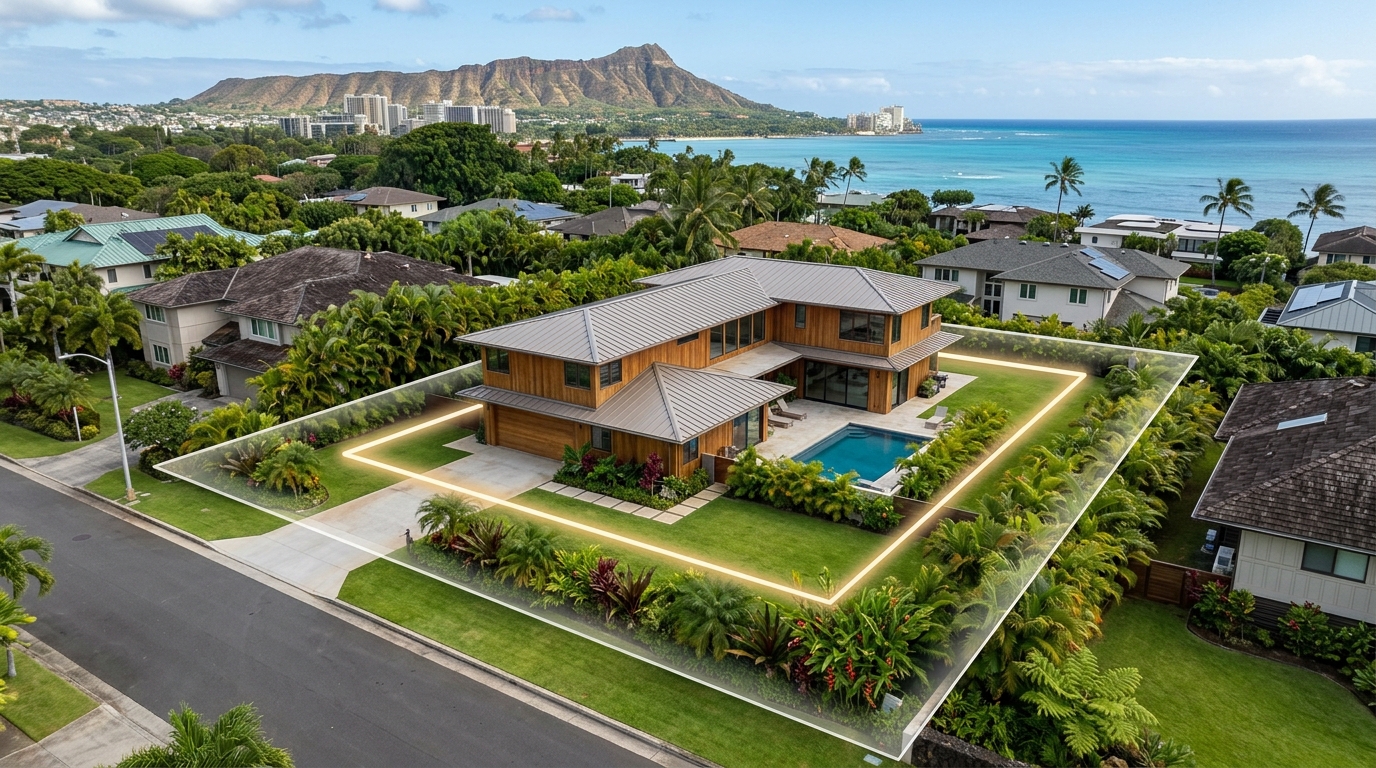
You have a 7,500-square-foot lot in Honolulu.
So how big of a house can you build?
Maybe 4,000 square feet? 5,000? After all, you own 7,500 square feet of land.
But here is where many homeowners get surprised:
Your lot size does not tell you how much house you can build.
In fact, two Honolulu lots with exactly the same square footage can have very different building possibilities.
The reason is that your lot size is only the starting number. Zoning, setbacks, building area, floor area, existing structures, the shape of the lot and other rules all come into play.
And one rule can affect another.
That is why answering “How much house can I build?” is less like doing one math problem and more like putting together a puzzle.
First, Find Out What Your Lot Is Zoned For
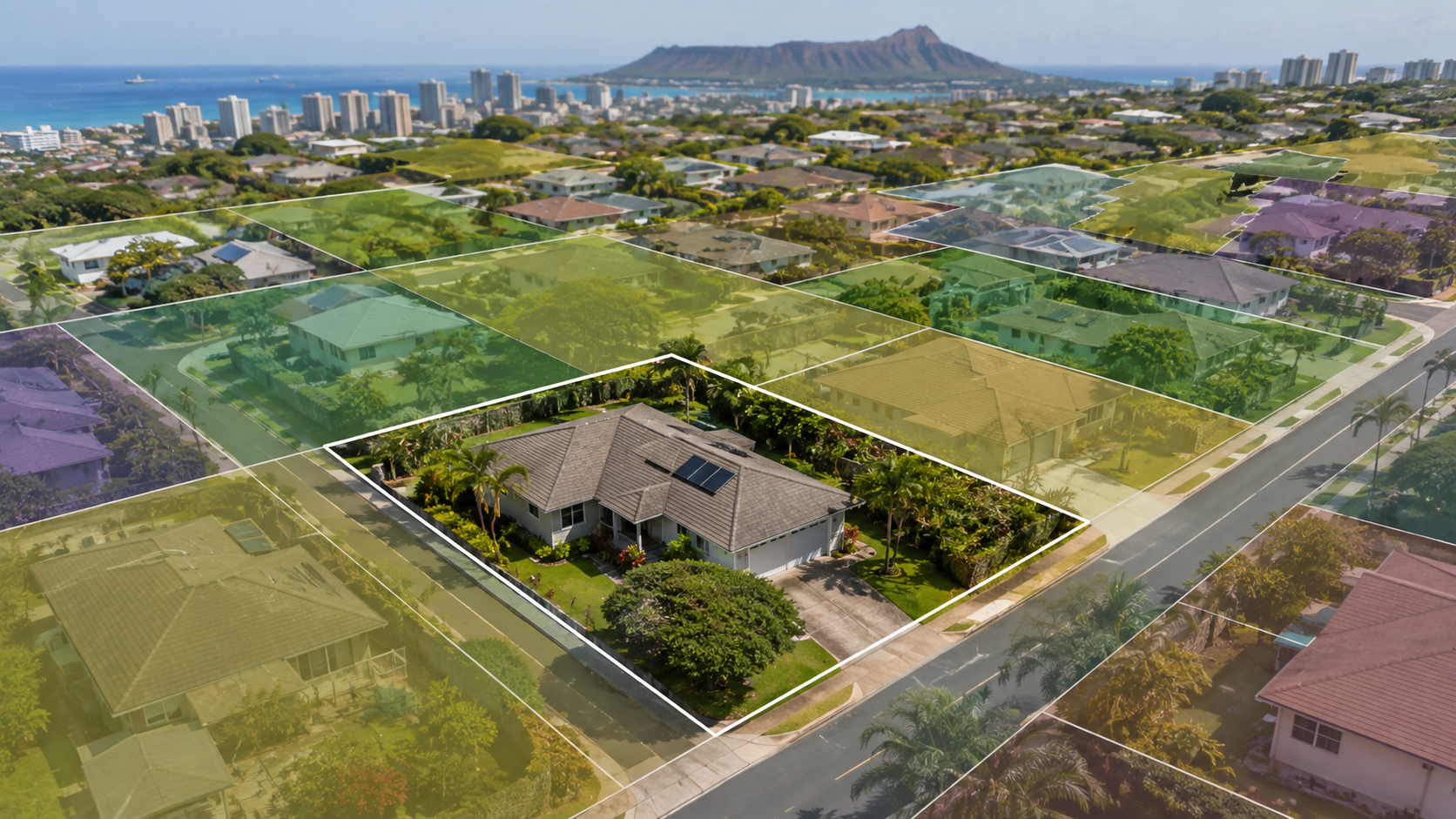
A 5,000-square-foot lot is not automatically the same as every other 5,000-square-foot lot.
The first thing to know is the property's zoning.
Honolulu has several standard residential zoning districts, including R-3.5, R-5, R-7.5, R-10 and R-20. The zoning tells you which set of development rules applies to the property.
And this is important: the size of your lot does not necessarily tell you its zoning.
Once you know the zoning, you can begin figuring out how much of the property can actually be used for your home.
That's when the numbers start getting interesting.
A 5,000-Square-Foot Lot Does Not Mean a 5,000-Square-Foot Building
For Honolulu's standard residential zoning districts, the current rules generally limit building area to 50% of the zoning lot.
So on a 5,000-square-foot lot, 50% would be 2,500 square feet.
Does that mean the biggest house you can build is 2,500 square feet?
No.
And this is where homeowners often get confused.
“Building area” and “floor area” are not the same thing.
Building area is basically the portion of your lot covered by structures and covered areas, with certain exceptions. Think of it roughly as how much of the land your buildings occupy.
But a house can have more than one floor.
So a two-story home might have considerably more total living space than the amount of land it covers.
That's where another important rule comes in.
Meet FAR: The Rule That Limits Total Floor Area
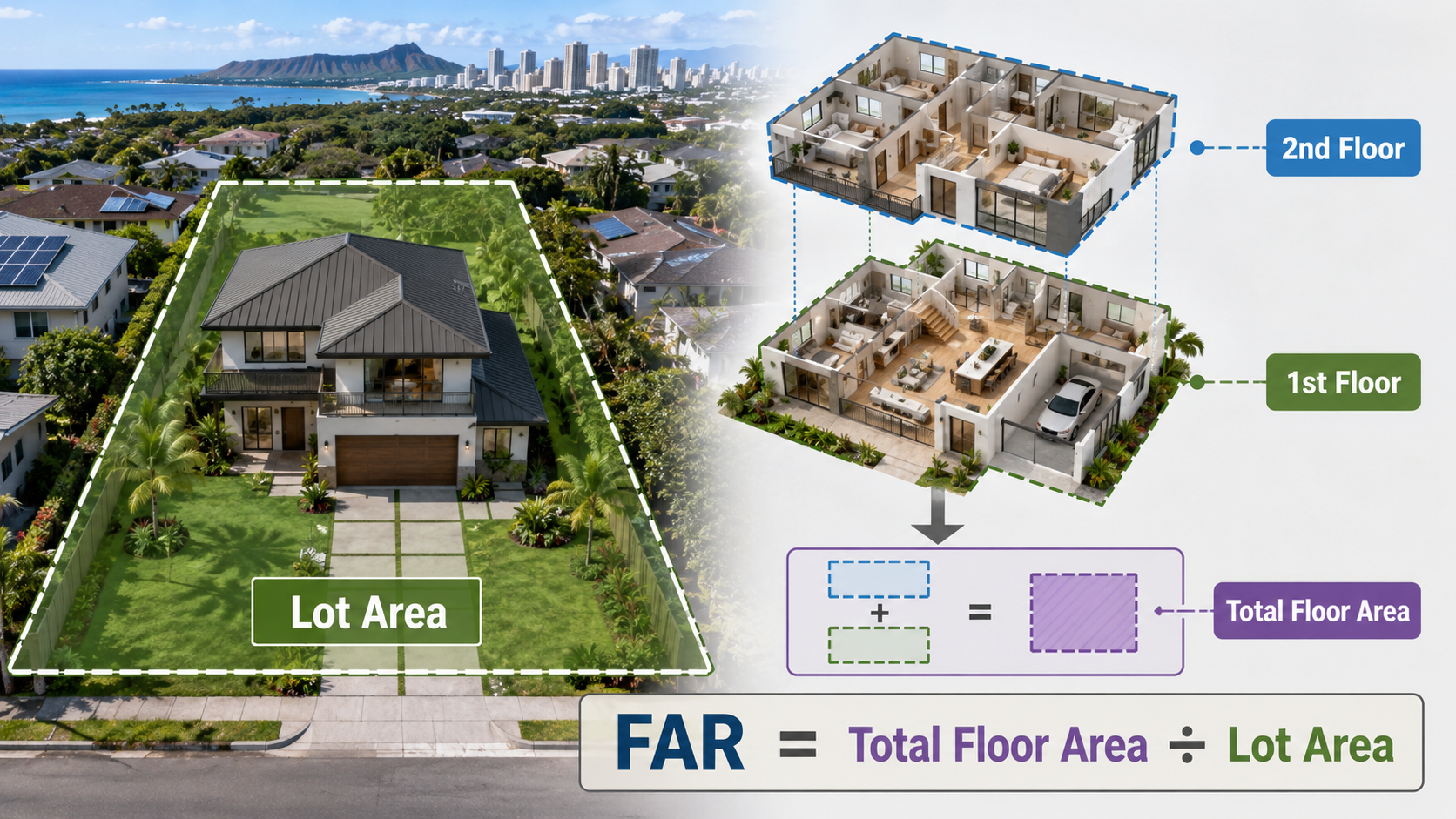
FAR stands for Floor Area Ratio.
The name sounds complicated, but the basic idea isn't.
FAR compares the amount of counted floor area in your buildings with the size of your lot.
For most dwelling projects in Honolulu's standard residential zoning districts, the maximum FAR is currently 0.7.
Here's a simple example.
If you had a 5,000-square-foot zoning lot:
5,000 × 0.7 = 3,500 square feet
That means the property could potentially have up to 3,500 square feet of floor area that counts toward FAR.
Notice what just happened.
The same 5,000-square-foot lot could have:
A 2,500-square-foot maximum building area
but potentially
3,500 square feet of counted floor area.
Those are two completely different limits.
And neither number, by itself, tells you exactly what house you can build.
Then Setbacks Shrink the Area Where the House Can Go
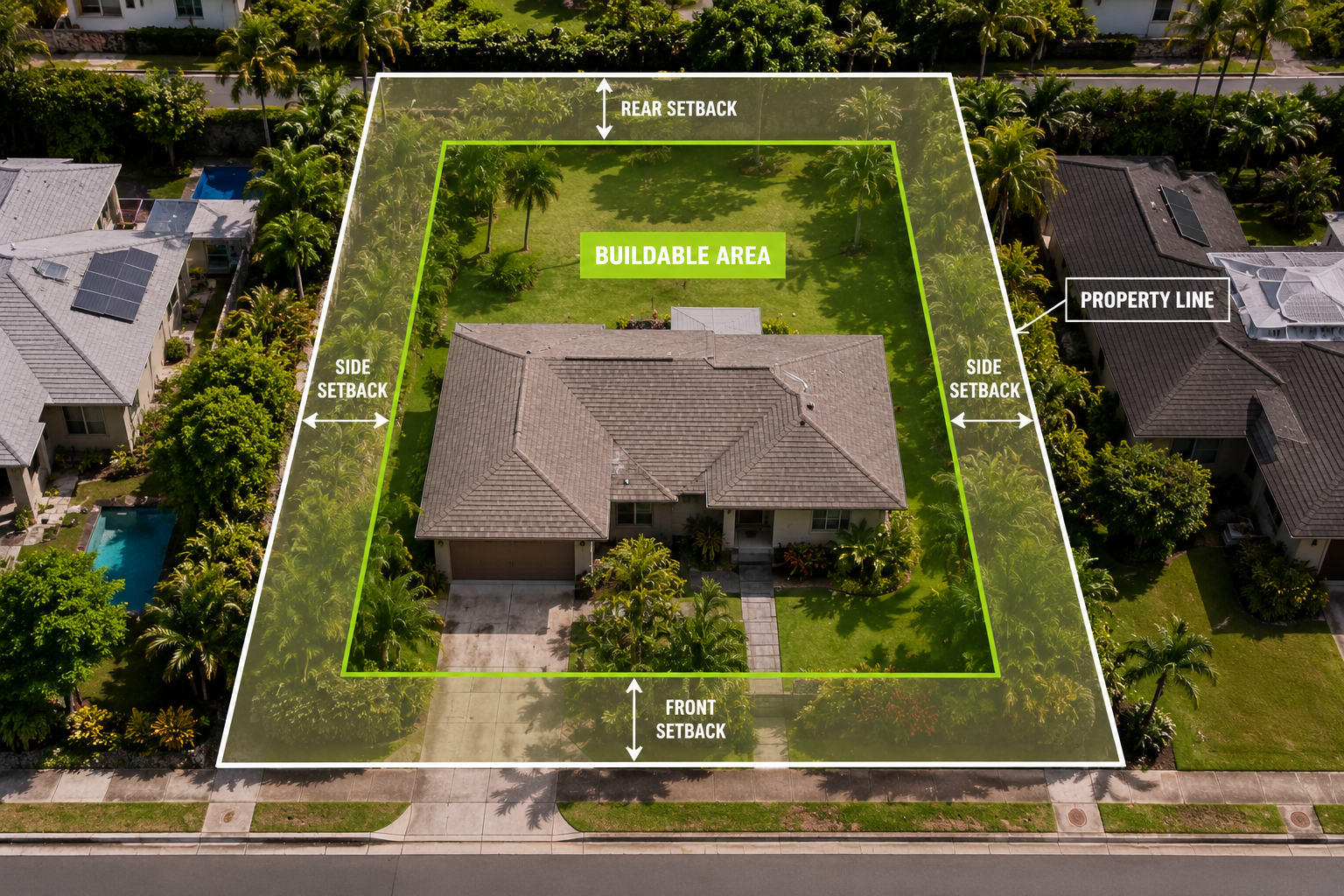
Now imagine drawing your property lines on the ground.
Your house generally can't begin right at those lines.
For typical single-unit, two-unit and duplex-unit dwellings in Honolulu's standard residential districts, the basic required yards are generally 10 feet in front and 5 feet along the sides and rear.
Once those required areas are taken out, what remains is essentially your buildable area.
But even that doesn't mean you can simply fill the remaining space with a house.
The 50% building-area limit still applies. FAR still applies. Height rules still apply. And other conditions may apply too.
This is why a wide rectangular lot can work very differently from a long, skinny lot with exactly the same square footage.
The acreage may be identical.
The house that fits may not be.
Want More Than 0.6 FAR? The Rules Change Again
Here's a Honolulu rule that can catch homeowners by surprise.
The maximum FAR may be 0.7, but once a dwelling project goes above 0.6 FAR, additional requirements kick in.
In the R-3.5 district, side and rear yards must increase to at least 8 feet.
In R-5, R-7.5, R-10 and R-20, they must increase to at least 11 feet.
There are also owner-occupancy requirements for dwellings that exceed 0.6 FAR.
Think about what that means.
You may technically be allowed more floor area, but reaching for that extra floor area can also shrink the part of the property where the house can sit.
That's a perfect example of why the biggest number allowed on paper isn't always the best—or even the easiest—house to design.
What If There Is Already a House or Garage on the Lot?
Now the puzzle gets another layer.
Suppose you have an older 1,600-square-foot Honolulu home and want to add a large second story.
The existing home may already be using part of the floor area allowed on the lot.
A garage can affect the property differently. Honolulu's FAR rules generally exclude parking structures such as garages from the floor-area calculation, but the garage can still occupy valuable physical space and may count toward building area.
So you can't simply look at the size of the lot, subtract the size of the old house and assume the difference is yours to build.
You have to know what counts toward which limit.
Older Honolulu Homes Can Bring Another Surprise
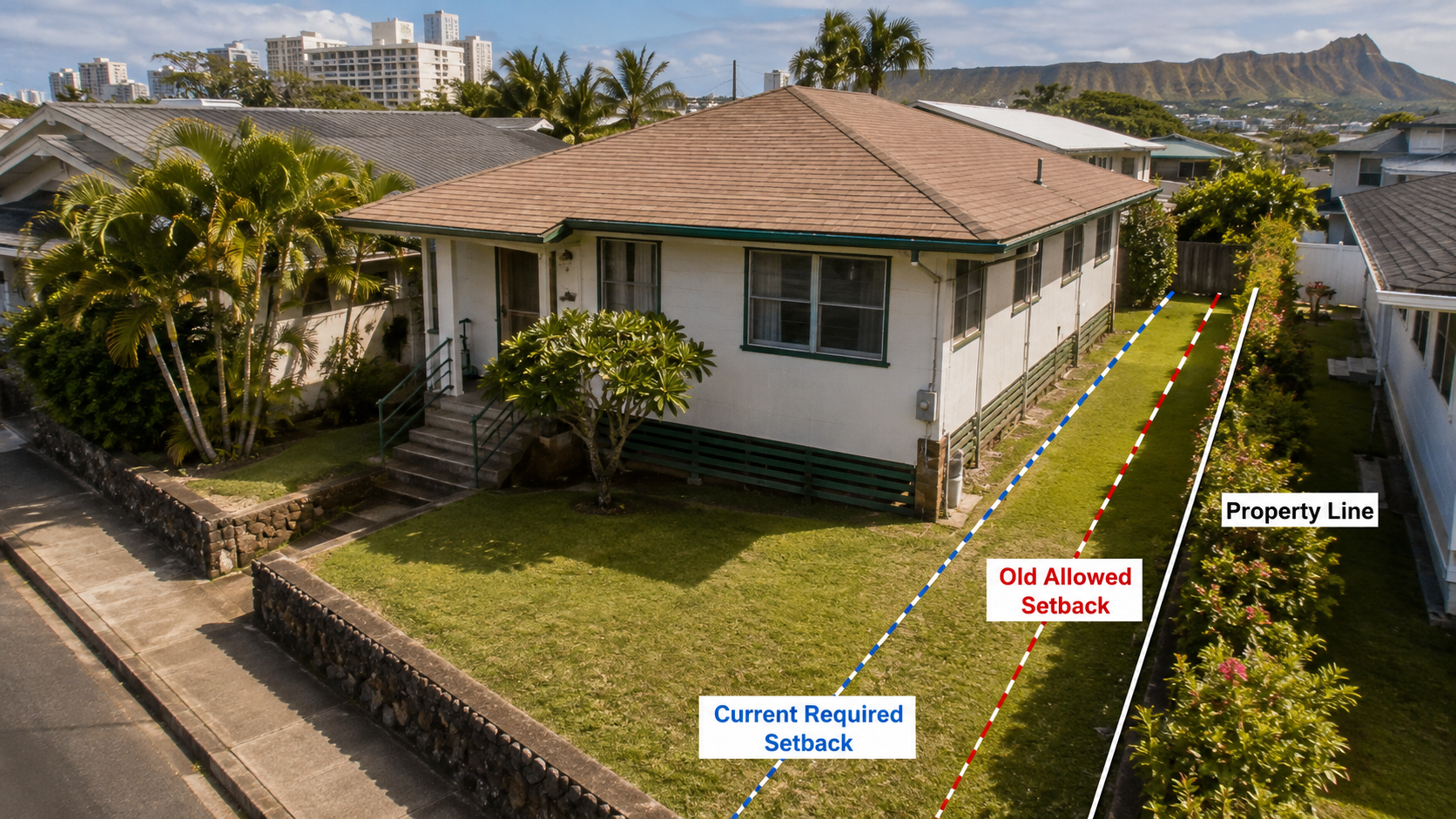
Many Honolulu homes were built decades ago under rules that were different from today's rules.
A legally built older house might sit closer to a property line, for example, than would be permitted for the same new construction today.
That can make it a nonconforming structure.
“Nonconforming” does not necessarily mean illegal.
It may simply mean the structure was lawful when built but doesn't meet one or more current zoning standards.
Honolulu allows legally established nonconforming structures to continue and, in some cases, to be repaired, altered or expanded as long as the work does not increase the nonconformity.
For a homeowner planning a major addition, that distinction can matter a lot.
Even the Paved Areas Around Your House Can Matter
Here's another limit that is easy to overlook.
Honolulu also regulates impervious surface area—areas where rainwater cannot easily soak into the ground.
For dwelling units covered by the current rule, impervious surfaces generally cannot exceed 75% of the zoning lot.
That can include more than the house.
Driveways, paved areas and other hard surfaces can affect the calculation too.
So a design that seems to work when you look only at the house may need to change when you look at the entire site.
So How Much House Can You Actually Build?
Now you can see why there isn't one quick answer based only on lot size.
An architect may need to look at:
- The property's actual zoning
- Lot size and dimensions
- Required front, side and rear yards
- The 50% building-area limit where applicable
- FAR
- Existing structures
- Lot shape and slope
- Height and height-setback requirements
- Impervious surfaces
- Parking and driveway needs
- Nonconforming conditions
- Special rules that may affect the individual property
Properties near shorelines, streams, flood-hazard areas or special districts can have still more requirements.
So if someone tells you, “You have a 7,500-square-foot lot, so you can build a _____-square-foot house,” without looking at the property itself, be careful.
Lot size is only the first clue.
The much better question is:
What can we actually design on this particular lot while meeting all the rules that apply to it?
And sometimes that answer is better than the homeowner expected.
Find Out What Your Honolulu Lot Can Really Do
If you're considering a new home, large addition or second story, it makes sense to understand your property's limits before spending time designing a house that may not fit them.
Home Planning Hawaii can review your property, your goals and the rules that apply, then help you understand what may realistically be possible.
Because before you ask, “What should our new home look like?” there is one very useful question to answer first:
How much home can this lot actually handle?
Get a free instant online estimate or call Home Planning Hawaii at (808) 978-9028 for expert help.

Recent Posts


Opening Hours
Mon - Sat 8:00 - 5:30,
Sunday - Closed
.svg)
Location
500 Ala Moana Blvd, Suite 7400
Honolulu, HI 96813


© Copyright 2025 Home Planning Hawaii. All Rights Reserved.
.svg)