

Cost Per Square Foot to Build or Remodel in Honolulu: 2026 Realistic Expectations
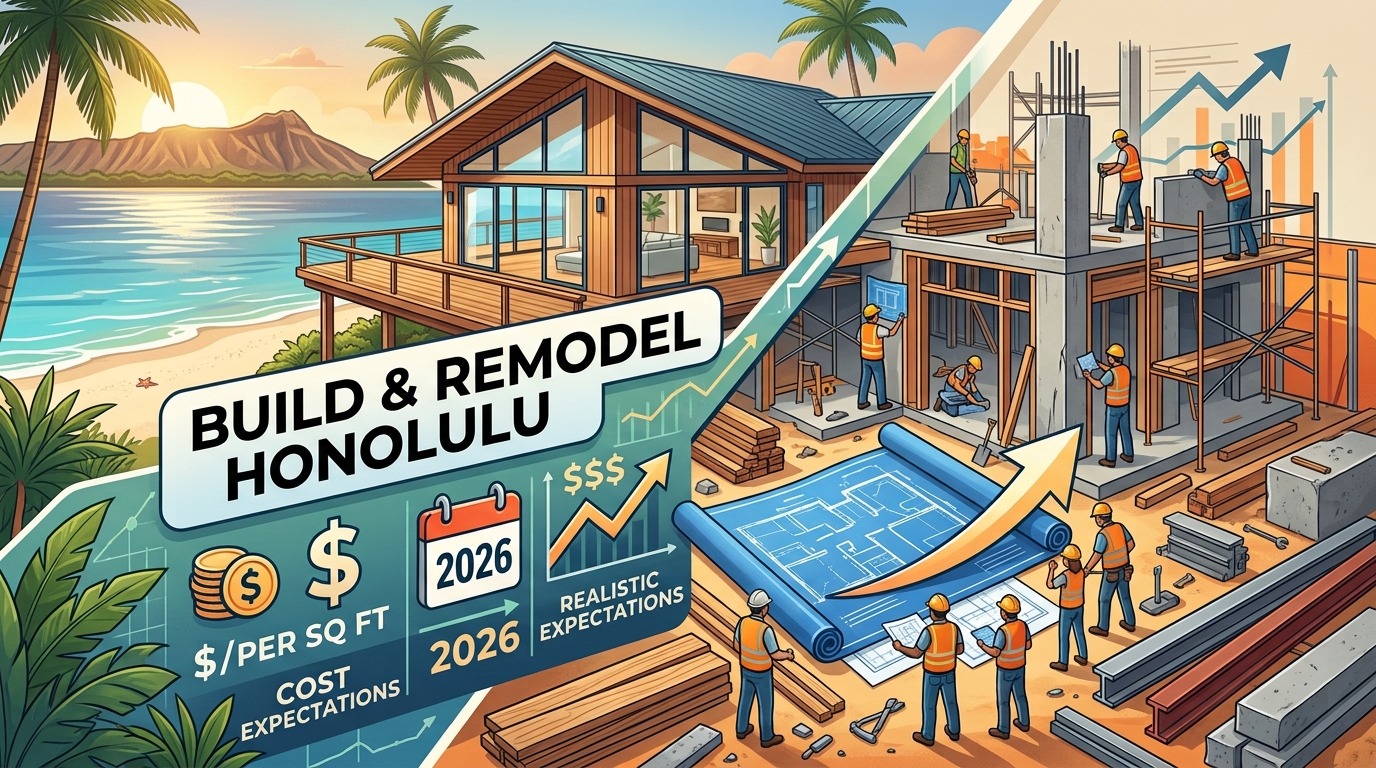
If you are planning to build or remodel a home in Honolulu, you probably want one simple answer:
How much will it cost?
The easiest place to start is with cost per square foot.
In 2026, new home construction in Hawaii often falls somewhere around $215 to $450 per square foot, depending on the home, the lot, and the finishes. Some Honolulu projects can cost more.
A full remodel can also vary widely, but a rough planning range may be around $180 to $490 per square foot, depending on how much of the house is being changed.
Those numbers may sound broad. But there is a simple reason for that:
Not all square feet cost the same to build.
A Simple Example
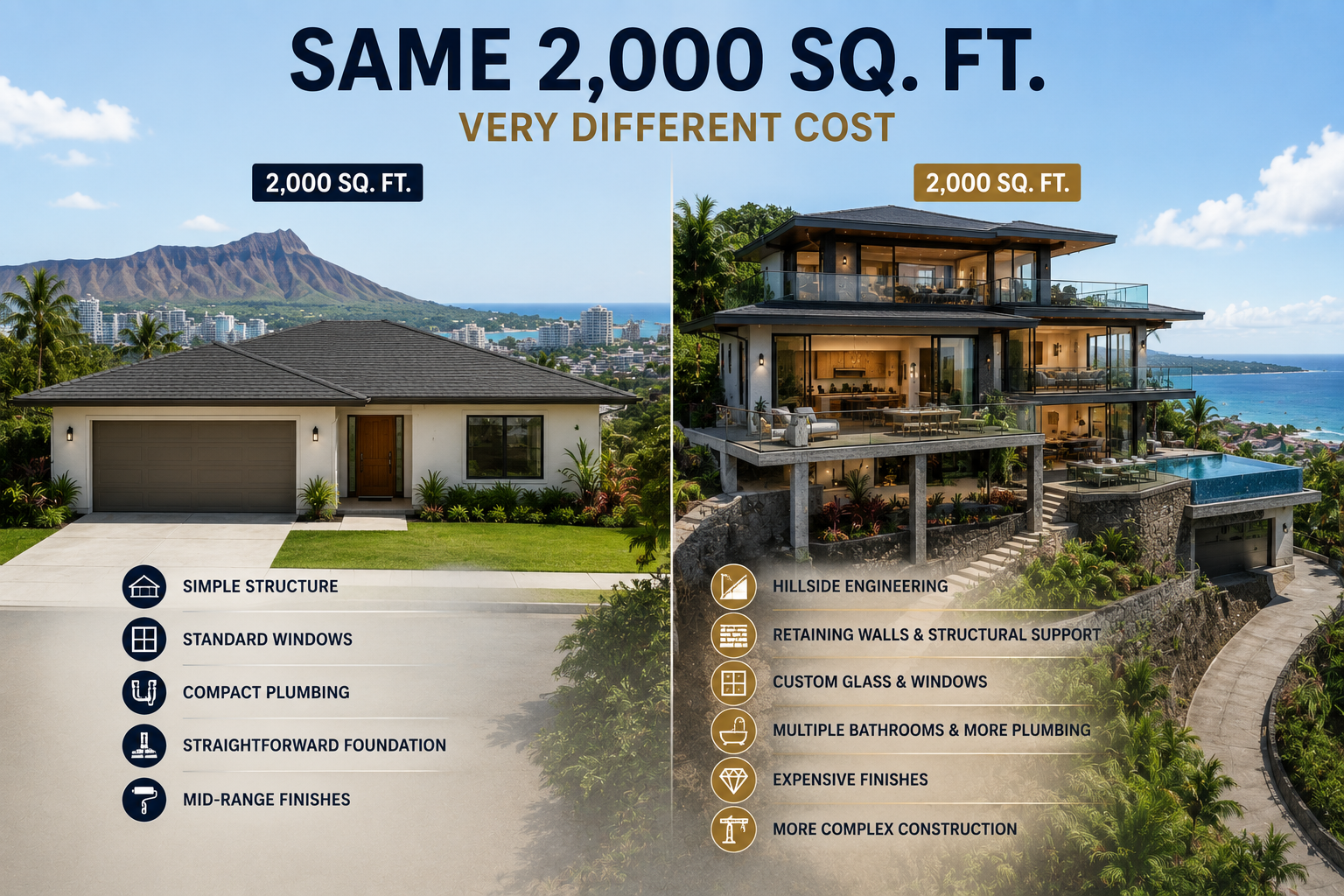
Imagine two 2,000-square-foot homes.
The first is a fairly simple house on a flat lot. It has a straightforward roof, standard windows, normal-size rooms, and plumbing grouped together.
The second is built on a steep hillside. It has large glass doors, custom windows, several bathrooms, long open spaces, and expensive finishes.
Both homes are 2,000 square feet.
But the second home may cost much more.
So cost per square foot is useful for getting into the right ballpark. It is not a final price.
The design of the home matters just as much as the size.
Why Building in Honolulu Costs More

One big reason is easy to understand:
Hawaii is far away from most of the materials used to build a house.
Many windows, doors, fixtures, appliances, cabinets, steel products, and finish materials have to be shipped across the ocean.
That adds freight costs.
Then those materials have to be stored, delivered, and moved to your jobsite.
Labor is also expensive. Honolulu has a limited number of skilled contractors, electricians, plumbers, carpenters, roofers, and other trades compared with large mainland markets.
Put those two things together—higher material costs and higher labor costs—and building in Honolulu becomes expensive very quickly.
What Makes a House Less Expensive to Build?
This is where homeowners have more control than they may realize.
A simpler house usually costs less to build than a complicated one.
For example, these choices can help control costs:
- A simple roof instead of many roof angles
- Standard-size windows instead of custom windows
- Kitchens and bathrooms located near each other
- Fewer complicated structural changes
- A simple building shape
- Durable mid-range finishes instead of luxury finishes
None of those choices mean the house has to look boring.
A good architect can often make a simple home feel open, bright, and custom without making every part expensive.
That is one of the biggest ways good planning can save money.
Remodeling Is Different From Building New
With a remodel, you already have a house.
That can save money because you may be able to keep parts of the structure, roof, walls, plumbing, electrical system, and foundation.
But remodeling also has one big problem:
You are working around what is already there.
That can make some projects surprisingly expensive.
For example, moving a kitchen across the house may mean moving plumbing, electrical lines, walls, and ventilation.
Removing a wall may require a new beam.
Adding a second floor may require strengthening the structure below it.
So the cost of a remodel depends heavily on how much you change.
A Light Remodel Can Cost Much Less
If you keep the basic layout and update what is already there, costs are usually easier to control.
You might replace:
- Flooring
- Cabinets
- Countertops
- Fixtures
- Lighting
- Paint
- Appliances
That is very different from tearing apart the floor plan and rebuilding large sections of the house.
This is why two homeowners can both say, “We are remodeling,” while one project costs $150,000 and another costs $700,000.
The word remodel can mean very different things.
Kitchens and Bathrooms Cost More Per Square Foot
This is another useful rule of thumb.
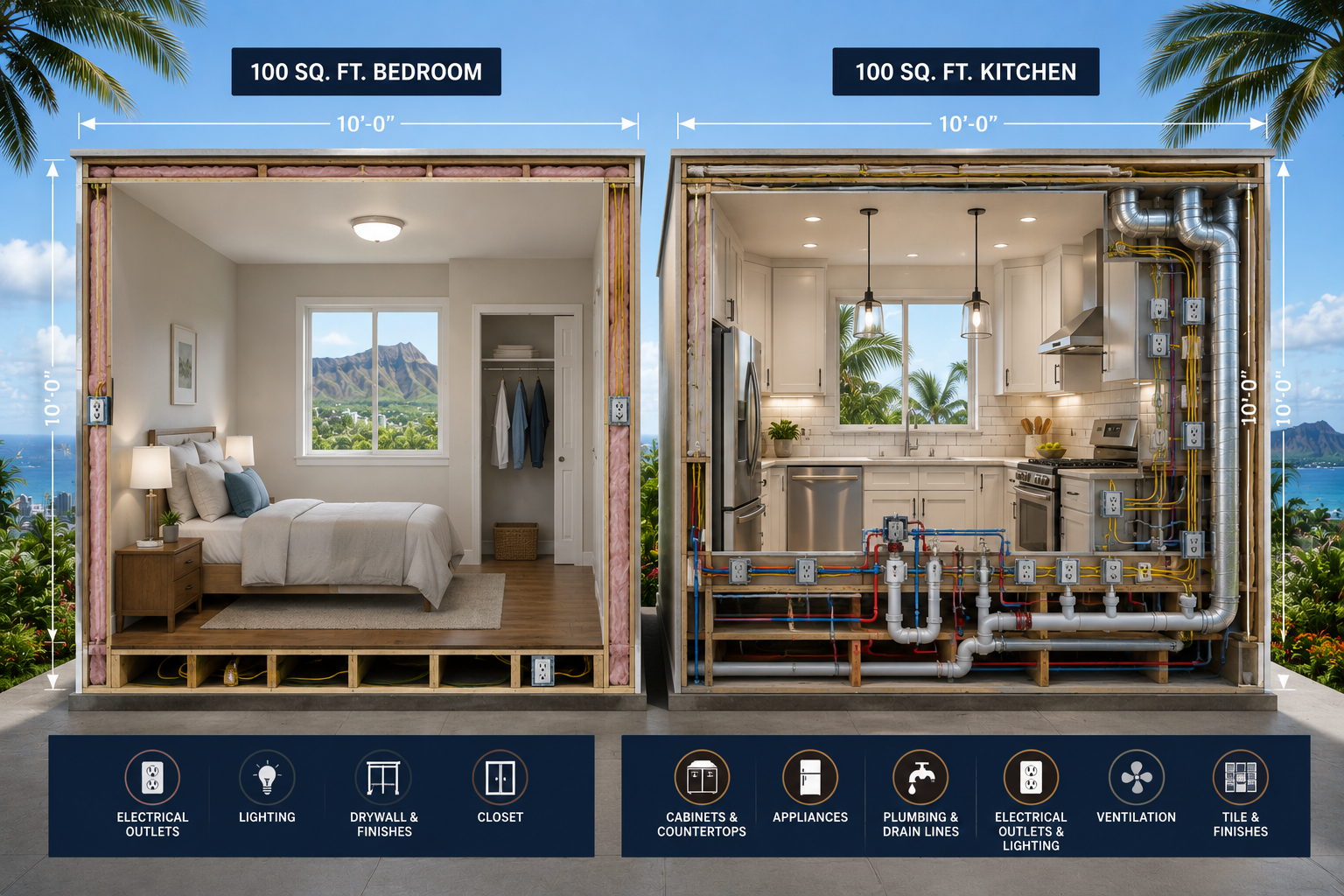
A bedroom is relatively simple.
It may have flooring, drywall, lights, outlets, windows, and a closet.
A kitchen has all of that plus cabinets, countertops, appliances, plumbing, electrical work, lighting, tile, and ventilation.
Bathrooms also pack a lot of expensive work into a small area.
That is why a 100-square-foot kitchen can cost far more than a 100-square-foot bedroom.
So when comparing remodeling prices, do not look only at the size of the project.
Look at what is inside those square feet.
Older Honolulu Homes Can Have Surprises
Remodeling an older home can uncover problems you could not see before construction started.
Once walls or floors are opened, a contractor may find:
- Termite damage
- Old plumbing
- Old electrical wiring
- Water damage
- Rot
- Structural problems
- Older work that needs to be corrected
That does not mean every old house is full of problems.
It simply means homeowners should keep some money in reserve.
For a major remodel, having a contingency in the budget can prevent a surprise from turning into a crisis.
The Best Time to Save Money Is Before Construction
This may be the most important part of the entire article.
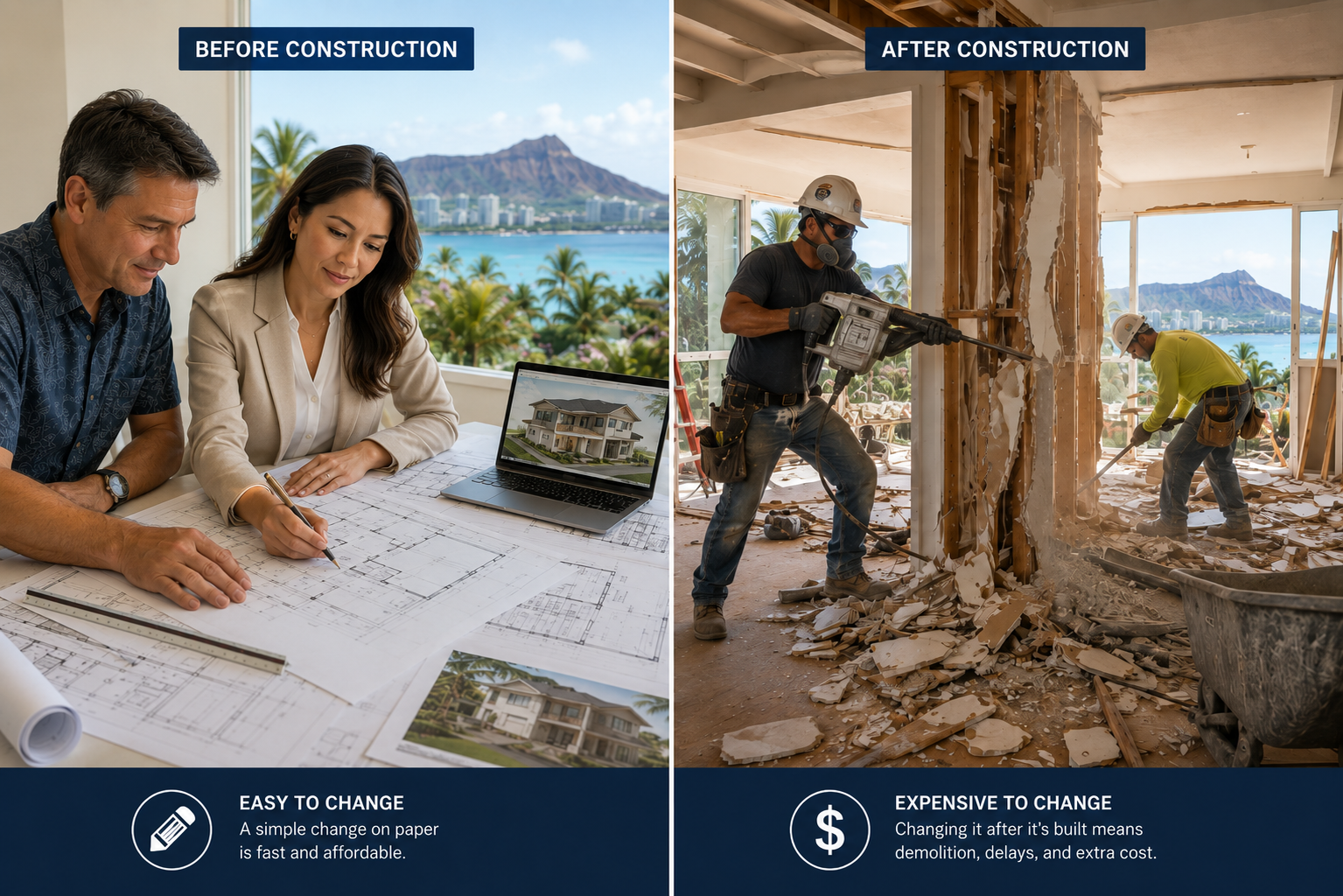
Once construction begins, changing the design can become expensive.
Before construction begins, changing the design may simply mean changing the drawings.
That is why early planning matters so much.
For example, an architect may be able to simplify the roof, move a bathroom closer to existing plumbing, avoid an expensive structural change, or reduce unnecessary square footage.
Those changes can save real money without making the finished home feel cheap.
This is sometimes called value engineering.
The term sounds complicated, but the idea is simple:
Spend money where it matters most. Avoid spending it where it does not.
Bigger Is Not Always Better
Homeowners often think they need more square footage.
Sometimes they do.
But sometimes they simply need the space they already have to work better.
A better floor plan can remove wasted hallways, improve storage, bring in more daylight, connect the living room to a lanai, or make one room serve two purposes.
For a new home, that may mean building a slightly smaller house that feels surprisingly spacious.
For a remodel, it may mean changing the layout so the existing house feels bigger without adding a large addition.
That can be one of the smartest ways to control a Honolulu construction budget.
So What Should You Expect to Spend?
For early planning in 2026, a homeowner might begin with roughly:
New construction: about $215 to $450+ per square foot
Major remodeling: about $180 to $490+ per square foot
But your real price will depend on what you are actually building.
A simple home on a flat lot may land toward the lower end.
A complicated custom home, steep lot, major structural remodel, or luxury project may land toward the higher end—or above it.
The most useful thing you can do is not chase the perfect cost-per-square-foot number.
Instead, start with three things:
What do you want to build?
What can you comfortably spend?
How can the design bring those two numbers together?
That is where good architectural planning becomes valuable.
At Home Planning Hawaii, we help Honolulu homeowners figure out what makes sense before construction begins—while there is still time to simplify the design, control costs, and make smarter decisions.
Ready to Find Out What Your Project May Really Cost?
If you are thinking about a new home, addition, or major remodel in Honolulu, the best time to get professional guidance is before you spend money on the wrong design.
Home Planning Hawaii can help you look at your lot, your goals, your budget, and the smartest way to move forward.
Get a free instant online project estimate or call Home Planning Hawaii at (808) 978-9028 for expert help with your Honolulu home project.

Recent Posts


Opening Hours
Mon - Sat 8:00 - 5:30,
Sunday - Closed
.svg)
Location
500 Ala Moana Blvd, Suite 7400
Honolulu, HI 96813


© Copyright 2025 Home Planning Hawaii. All Rights Reserved.
.svg)